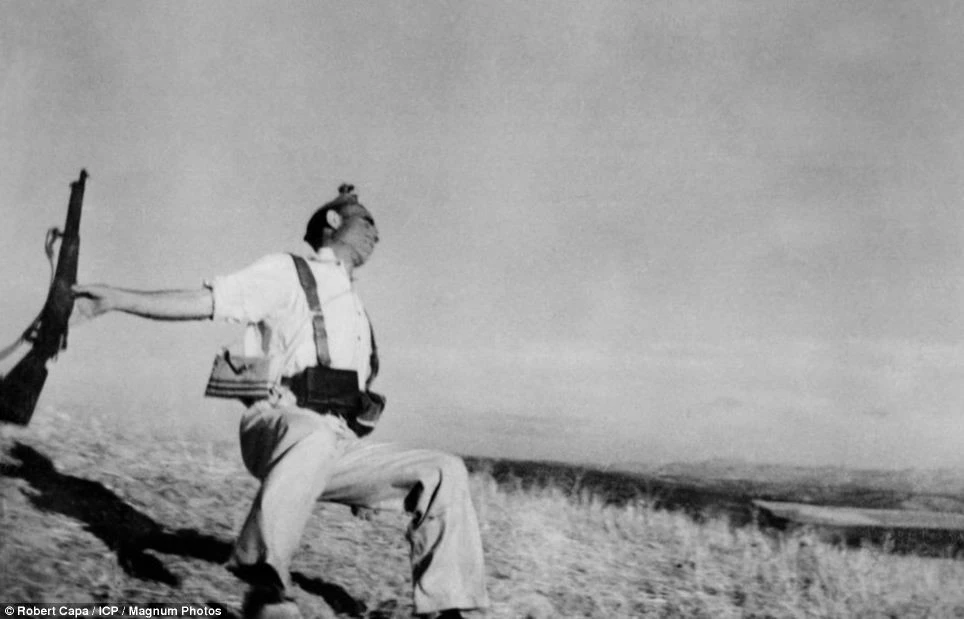
“If your pictures aren’t good enough,
then you aren’t close enough” – Robert Capa (1913 – 1954)
Robert Capa, was born ‘Andre Friedman’, in Hungary in 1932 to Jewish parents. He studied political sciences in Germany. He left Germany at the beginning of the rise of the Nationalist Socialist party in 1933, (Friedman) moved to Paris, not knowing how the future rise of the Nazi party would affect his adopted country. In his move to Paris ‘Friedman’ met and worked with the photographer and journalist Gerda Taro. It was here that ‘they’ invented a ‘famous’ American photographer, represented by ‘Alliance Photo’, they found clients and sold ‘Friedman’s’ images. ‘Robert Capa’ was born.
During this both inventive and commercially successful time, Capa’s network of friends expanded, to include the names of: Hemingway, (Chim) Seymour and the painter Pablo Picasso. One can only imagine the conversations that this group might have had, ‘oh to be a fly on the wall’, in their company.
1936, saw Robert Capa covering the civil war in Spain, Capa’s pictures soon began to appear in the popular press, his image of a soldier, captured at the moment he was shot dead, only underlined his reputation, and, his photography, it then catapulted him on to the international stage.
In 1938, Robert Capa move to China, after the death of his close friend Gerda Taro. He remained in China for twelve months. After this time, Capa decided to emigrate to the USA, and settled in New York. At last, with this move, it finally made him the famous ‘American’ photographer! At this time in 1939, the Second World War had just begun and the Nazi regime were ‘bullying’ its way across Europe, throughout World War II, he covered the action in Africa, Sicily and Italy. It was at this stage in his career that Capa was working for ‘Life’ magazine.
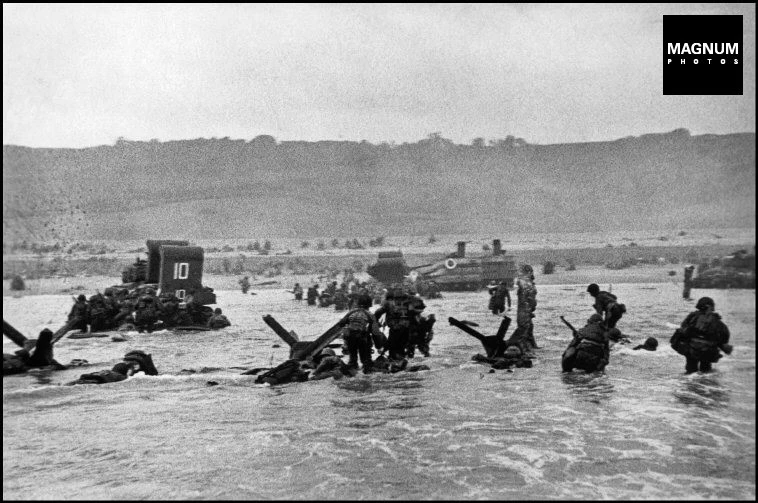
Robert Capa was truly in the thick of the action during the D-Day landings. It was here, where he accompanied the first wave of the invasion, and was alongside the allied American troops, as they landed at the exhaustively defended Omaha beach.
Robert Capa submitted a total of four rolls of 35mm film from the battle, and this was rushed to Life magazine, Capa’s D-Day coverage reached Life magazine some 24 hours later. On reaching the magazine’s offices, John Morris, the photo editor, requested that these films were to be (understandably) ‘rushed’.
It is understood that a hysterical darkroom assistant came to Morris later that day saying that: “all the films were ruined !”. This happened after placing for rolls of developed film in the drying cupboard, the doors were (unusually) closed. This meant, that too much heat had allowed the emulsion on the film(s) to run, and out of four rolls submitted: only 11 frames were salvageable, from one roll of film. [It is my own personal belief, that, it was not simply the case of blurred images used for dramatic effect, over far more sharp frames, they were used because, these were all they had!].
It was two years after the war, in 1947 when Robert Capa, Henri Cartier-Bresson, David Seymour, George Rodger and William Vandivert, co-founded Magnum Photos. A company founded by a band of brothers that is still in existence today.
Whilst Robert Capa may have seemed (to others) as simply risking his life for photography, in the end, he risked his life for reality, on the 25th of May 1954, he did, just that, whilst covering a photo assignment in Thai-Binh, in Indochina, he inadvertently stood on a landmine, and was killed. The French Army had honoured him with the’ Croix de Guerre with Palm’ post-humously.
Footnote
In stark contrast, Tony Viccaro an American soldier who, alongside his rifle was also requested, or rather instructed to carry a camera, and become an army photographer. Viccaro, had to develop his own films, quite often using soldiers helmets as developing dishes, with chemicals found in a bombed out chemists store. Tony Viccaro, in his own words also captured the true battles of war. However, all his perfectly developed films were destroyed by the armies’ censorship, as they portrayed death, something the American public, quite understandably would not endure.
Bibliography
Robert.dailymail.co.uk, Capa,. Death of a Loyalist Soldier . Available from:http://www.dailymail.co.uk/news/article-2467382/Incredible-war-photos-Robert-Capa-born-100-years-ago-week.html[accessed 12 October 2026]
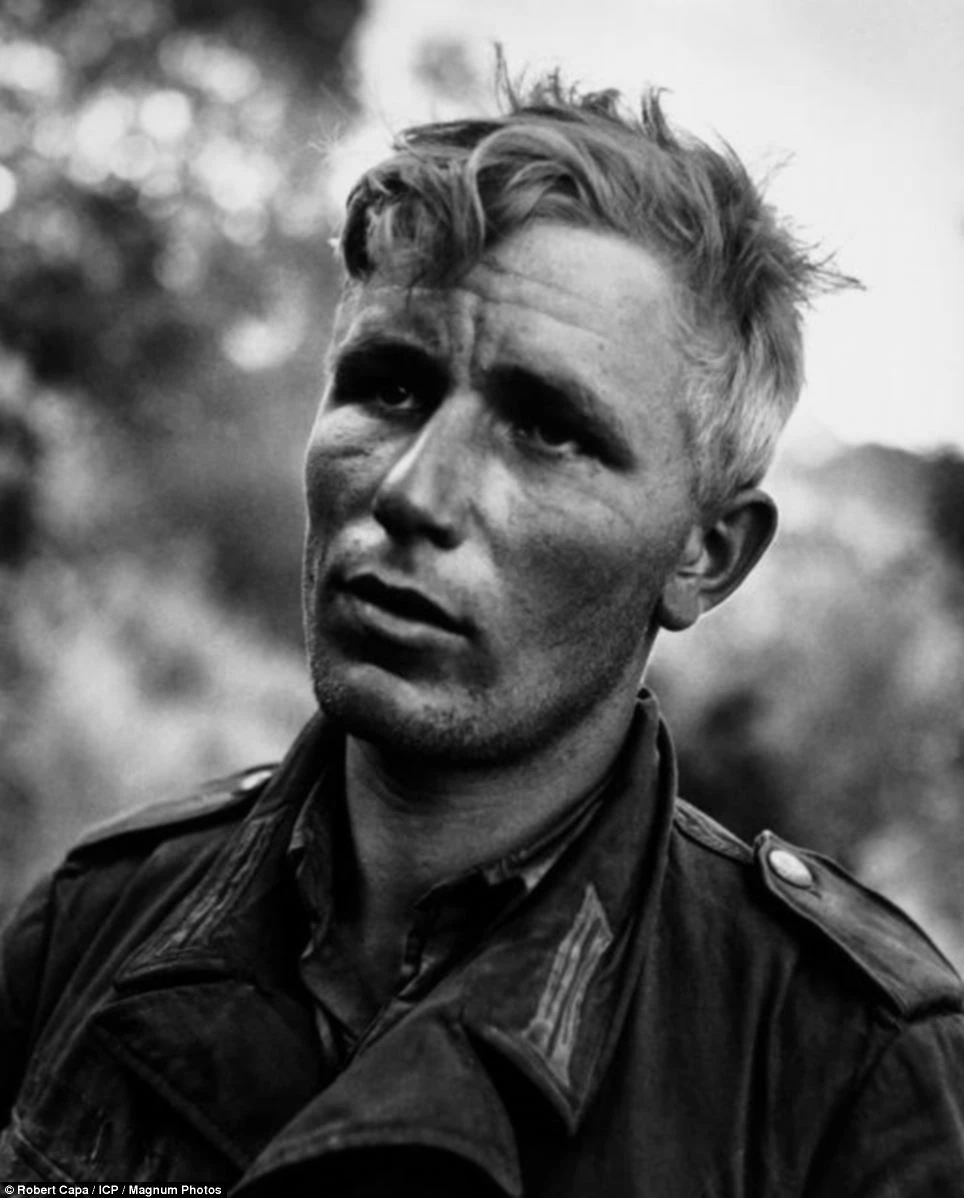
IA German soldier after he had been captured by Ame. Available from:http://www.dailymail.co.uk/news/article-2467382/Incredible-war-photos-Robert-Capa-born-100-years-ago-week.html[accessed 12 October 2026]
Robert Capa’s greatest war photo ‘was a lucky shot’ – BBC News Availablefrom:Robert Capa’s greatest war photo ‘was a lucky shot’ – BBC News [accessed 12 October 2026]